
Agentic Coding Workflows: How to Ship Reliable Software With AI Agents
A practical guide to using coding agents for planning, implementation, testing, and review without confusing generated output for finished software.
Abhishek Raj
A coding agent that produces a thousand-line pull request in ten minutes has not saved you time if it takes two days to understand whether it is safe. Agentic coding works when the agent is treated like a fast junior collaborator with excellent recall and zero product intuition.
My production work includes systems where a small change can touch customer flows, operational queues, and compliance logic at the same time. That has made me allergic to impressive-looking diffs that nobody can explain. The fastest AI-assisted change is usually the one that stays narrow enough for me to review without reconstructing the entire system in my head.
The Brief That Prevents Expensive Rework
Give an agent a job it can finish and a reviewer can verify. A strong brief names the user-facing outcome, files or systems in scope, invariants that must not change, acceptance checks, and the command that proves success.
Compare "fix checkout validation" with "reject an expired coupon before payment submission, preserve the API response shape, and add tests for expired, valid, and missing coupons." The second prompt is not more verbose for the sake of it. It removes three opportunities for the agent to invent product behavior.
Make Planning a Separate Deliverable
For anything beyond a small edit, request a plan first. A useful plan identifies the existing pattern, the impacted files, the intended data flow, risks, and test strategy. Review this before the agent edits. Five minutes of correction at planning time can prevent an hour of code review.
If the plan cannot name the relevant code paths, that is a signal to improve context—not a reason to let the agent search and rewrite more broadly.
The Two-Loop Method
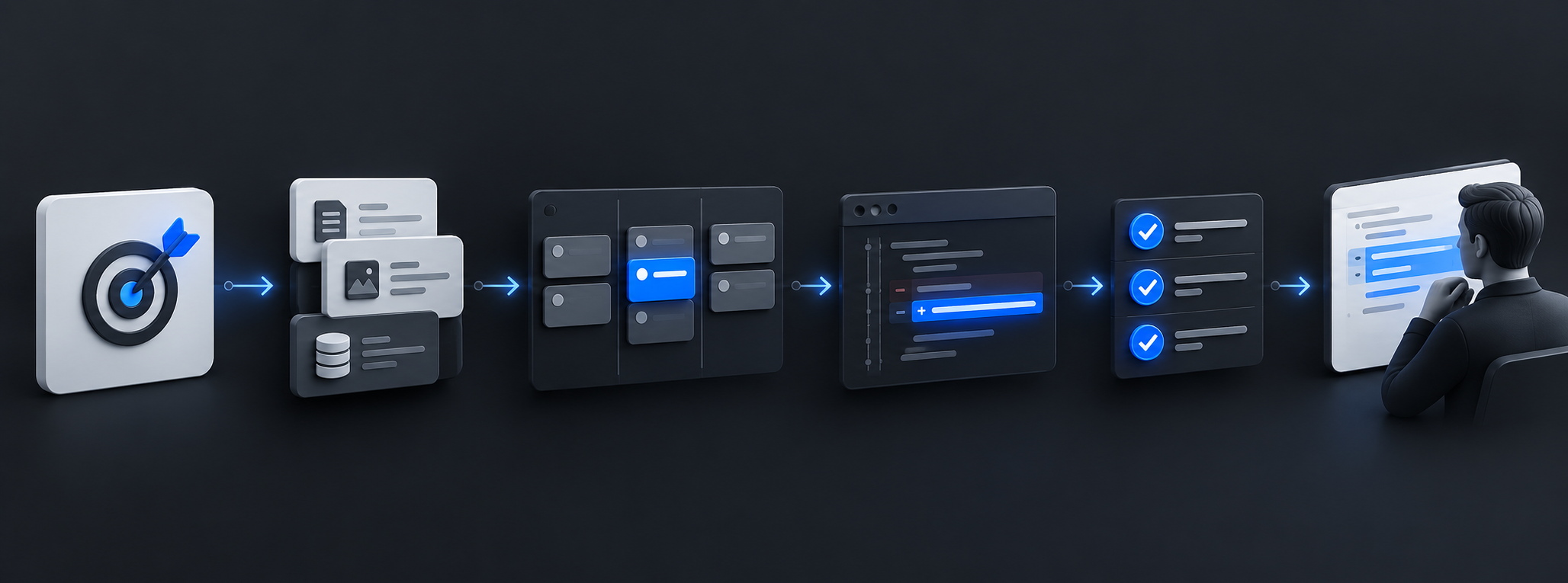
Use one loop for creation and another for proof. In the creation loop, the agent inspects, plans, and edits. In the proof loop, it runs type checks, tests, builds, and targeted browser or API checks; then it reports failures and evidence. Keep the loops distinct so a confident summary cannot disguise an untested change.
For production work, I want the handoff to include: changed files, assumptions, commands run, results, and known gaps. This makes review asynchronous and makes failures teach the next run.
Review What Changed, Not How It Sounds
AI explanations are cheap. Diffs are evidence. Review authorization paths, error handling, schema changes, dependencies, migrations, analytics, and tests that could pass without testing the intended behavior. Ask one ruthless question: is this the smallest change that satisfies the requirement?
This is not mistrust of the tool. It is good engineering. The same standard applies to code written by a colleague at 2 a.m. or generated by an agent at 2 seconds.
A Safe Default Workflow
Use agents freely for exploration, test drafts, refactors with strong test coverage, and mechanical migrations. Add human approval for secrets, permissions, payments, destructive operations, and public communication. Stop automatic retries when the evidence is ambiguous; escalation is a feature, not a failure.
The goal is not autonomous shipping. The goal is a development loop where a developer spends more time making decisions and less time performing the mechanical work around them.