
How to Evaluate AI Agents in Production: Metrics That Actually Matter
A production AI agent needs more than a clever demo. Evaluate task success, safety, latency, cost, recovery, and the quality of human handoffs.
Abhishek Raj
An AI agent is easy to admire when it solves a hand-picked example. Production is different: inputs are incomplete, tools fail, policies change, and users ask for things you did not anticipate. Evaluation is the discipline that closes the gap between an impressive demo and a reliable product.
In operational software, I have found that the painful failure is rarely a visible crash. It is work that appears complete but is routed incorrectly, a field that looks valid but breaks a later process, or an edge case that only surfaces after a customer follows up. That is the bar I bring to agent evaluation: can we detect a bad result before it becomes somebody else's problem?
Start With a Task-Level Definition of Success
Define success from the user's perspective. For a support agent, it may be a correct, policy-compliant resolution. For a coding agent, it may be a reviewed change that passes tests and does not create regressions. A fluent response is not enough.
Build a small evaluation set from real, anonymized tasks. Include routine cases, edge cases, ambiguous requests, malicious instructions, missing data, and tool failures. Keep the set versioned as the product evolves.
Measure More Than Accuracy
Track task success rate, groundedness or citation quality, tool-call correctness, human escalation rate, retry rate, latency, token cost, and recovery after a failure. The right metric depends on the workflow, but every metric should connect to a product or operational outcome.
Segment results by task type, model version, prompt or policy version, and tool version. An aggregate score can hide a dangerous regression in one important path.
Use Both Offline and Online Evaluation
Offline evaluation gives you a safe repeatable benchmark before release. Online evaluation shows what happens with real traffic, changing data, and actual user behavior. Use staged rollouts, sampled transcript review, user feedback, and monitoring to connect the two.
When possible, compare the agent with the existing workflow, not an imaginary perfect answer. The question is whether it improves the experience safely and sustainably.
Evaluate the Whole System
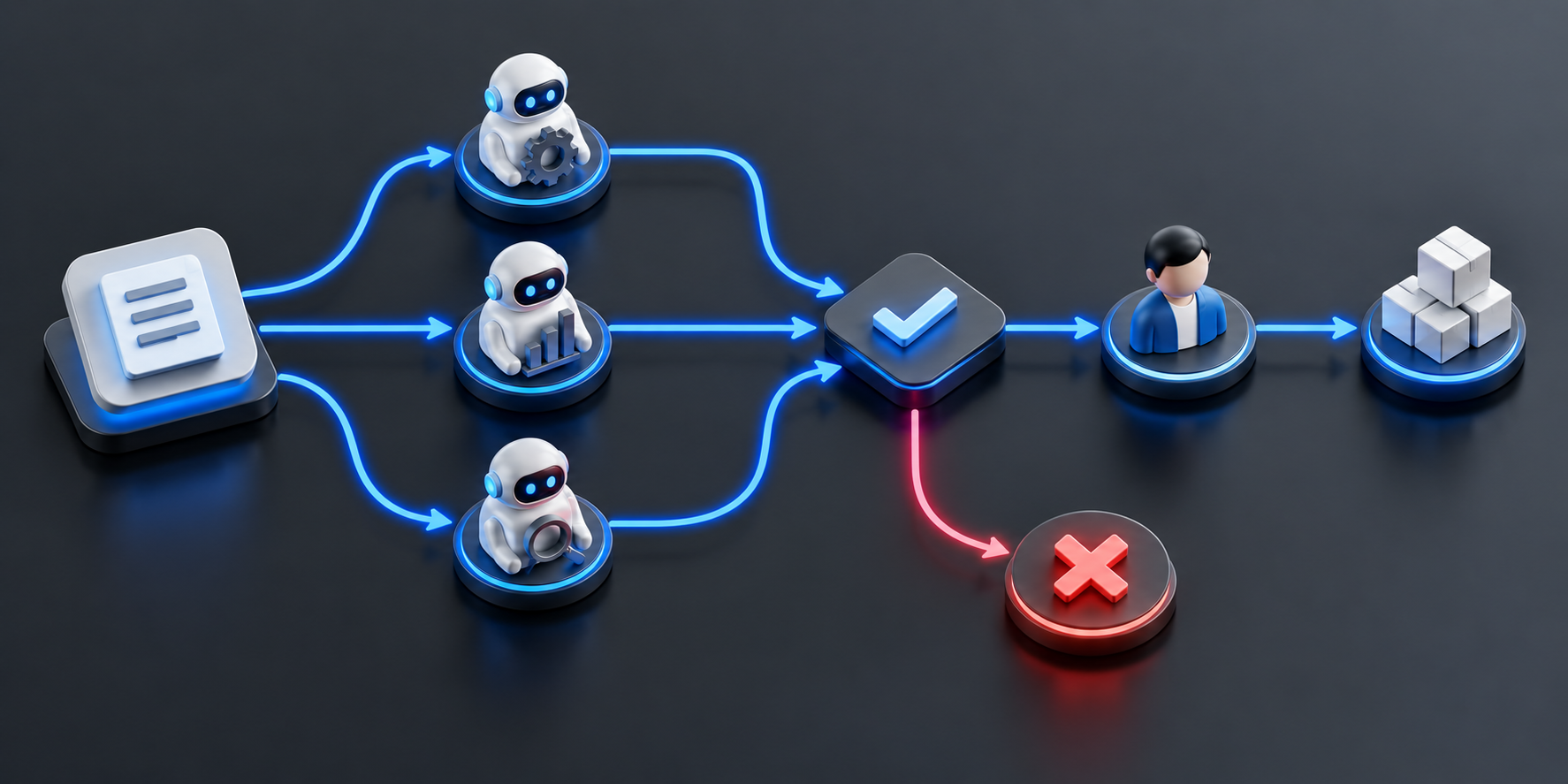
Most failures are not model failures alone. Retrieval may return outdated policy. A tool may be ambiguous. A workflow may skip an approval. Evaluation should trace the complete chain: context, model decision, tool selection, tool response, final output, and human action.
This is also how teams find the highest-leverage fix. Often a clearer tool schema or better source document improves reliability more than changing models.
Make Evaluation Continuous
AI behavior changes when models, prompts, tools, data, and users change. Run regression evaluations in CI where possible, monitor production continuously, and turn important failures into new test cases. Evaluation is not a launch checklist. It is an ongoing part of AI-native engineering.
The Friday-Morning Test
Could you explain a bad decision to a customer using the input, source, tool call, version, and recovery action? If not, you have a demo with production traffic, not an operable agent.